Drag the "Image" button to the top of this page. Then click on it and upload your banner.
|
"THE NEAPOLITAN MASTIFF:
Lurking from the mist of the ages emerges over 100 pounds of the strongest animal on earth, pound for pound. Legend says part lion, gargoyle and dog - but unlike any animal you've ever encountered. It moves like a lion, fights like a bear, and has an unmatched devotion for its master. The dog that fought in the coliseum and followed man into battle. The protectors of family and estates for thousands of years. Modern people cannot fathom the power of the Neo. It was the neo's likeness that was used as gargoyles on ancient buildings. The neo was Ceasar's bodyguard and Genghis Khan's war dog.... friend to Michelangelo, Leonardo, and Alexander the Great. The neo has come down the long 50 centuries unchanged. It was a Neo they spoke of when they wrote, "Then let slip the dogs of war." In spite of the terrifying countenance of the Neo, he or she is a soul of love and commitment to his or her family. Cognizant of and responsive to the frailties of the elderly, handicapped and children. The family's best friend, the intruder's worst nightmare!! What is it with the Neo that commands such a rush of awe? No other dog has this presence. Leonardo and Alexander the Great chose the Neo. Why? Because of the ferocious bond he or she forms with his or her family. Why have people been reproducing the Neapolitan Mastiff almost unchanged for over 5,000 years? Once you own one, you'll understand." The 10 most important things to know about canine hip dysplasia12/11/2015
By Carol Beuchat PhD Hip dysplasia is a hot topic in dogs, if it's possible to stay "hot" for 50 years. Researchers have been working hard for decades looking for solutions, and breeders have been doing their best to reduce the risk of producing affected puppies. But still the problem remains. There are some simple things we could do to reduce the incidence of hip dysplasia now if we understand a few basic things. Here are the 10 most important things you need to know. 1) All puppies are born with perfectly normal hips Hip dysplasia is not a congenital defect; it is not present at birth. Multiple studies have demonstrated that all normal puppies are born with "perfect" hips; that is, they are "normal" for a newborn with no signs of dysplasia. The structures of the hip joint are cartilage at birth and only become bone as the puppy grows. If a puppy is going to develop hip dysplasia, the process begins shortly after birth. This is the hip joint of a 1 day old puppy. The cartilage tissue does not show up on an x-ray until the minerals are deposited that form bone. Proper development of the joint depends on maintaining the proper fit between the head of the femur and the socket (acetabulum). "The hip joints of all dogs are normal at birth. The joints continue to develop normally as long as full congruity is maintained between the acetabulum and the femoral head... The acetabular rims are stimulated to grow by mild traction applied by the joint capsule and gluteal muscles attached along their dorsal borders, and from pressure by the femoral heads upon the articular surfaces... The morphologic characteristics of the complex hip structure show that biomechanical behavior is the prime influence in the growth of this joint." (Riser 1985) 2) The genes that cause hip dysplasia remain a mystery Hip dysplasia tends to be more common in some breeds than others and in some lines than others, which indicates that there is a genetic component to the disorder. However, scientists have been looking for genes that are responsible for the development of hip dysplasia in dogs for decades without success. Genes that are associated with hip dysplasia have been identified in some breeds, but they are breed-specific; that is, the assortment of genes is different in every breed. (For example, see studies on the German Shepherd dog (Marschall & Distl 2007, Fells & Distl 2014, and Fels et al 2014), Bernese Mountain Dog (Pfahler & Distl 2012), and Labrador Retriever (Phavaphutanon et al 2008). Genes that could cause hip dysplasia have not been found in any breed. It's unlikely that researchers are going to discover an easy genetic solution to the problem of hip dysplasia. It is a complex trait that is influenced by both genes and environment, and there is no simple solution just over the horizon. We should be able to improve genetic progress by using selection strategies that are as efficient and effective as possible such as estimated breeding values, EBVs. One great advantage of using EBVs is that the genes responsible for a trait don't need to be known; you need only a pedigree database and information about affected animals. 3) Environmental factors are also important Although there is a genetic influence on hip dysplasia, the heritability of the trait is rather low. Many studies have shown that genetic variation accounts for only a modest fraction of the variation in hip scores, usually 15-40%. This means that some fraction of the variation in the quality of the hips is the result of non-genetic, or "environmental" influences. This is one reason why decades of strong selection has resulted in only modest reductions in hip dysplasia in some breeds. At the current rate of progress and selecting only by phenotype, it could take decades to achieve a meaningful reduction in the incidence of hip dysplasia (Lewis et al 2013). Understanding the specific environmental factors that play a role in the development of hip dysplasia should allow us to reduce the number of animals affected by hip dysplasia even if the genetic basis is not yet understood. This would reduce significant pain and suffering as well as the expense and heartache endured by owners of an afflicted dog. There is no reason why we should not be taking active steps to do this now. The top three environmental factors that have been found to play a significant role in the develop of dysplastic hips are: a) joint laxity, b) weight, and c) exercise (see below). 4) Joint laxity is the primary cause of hip dysplasia Puppies are born with perfect hips, and if the hips do not develop laxity the dog does not develop hip dysplasia (Riser 1985). Joint laxity occurs when the head of the femur does not fit snugly into the acetabulum. This could be the result of traumatic injury, overloading of the joint by weight, lack of muscle strength, or adductor forces (e.g., bringing the legs together). Joint laxity is the primary factor that predisposes a dog to the development of hip dysplasia. In dogs as well as many other vertebrates (including humans), the head of the femur in newborns is held securely in place by a strong ligament variously called the "round ligament" or "teres ligament". One end of this ligament is attached to the head of the femur and the other end to the inner wall of the acetabulum (the cup-like socket on the pelvis). You can see the teres ligament in this illustration (labeled "LIGAM. TERES"). If this ligament is damaged or severed, the femur will not be held tightly in the socket, which will cause the joint to feel "loose". If the femoral head is not positioned properly in the socket, the forces on the hip will be abnormal. Instead of being distributed across the inner surface of the socket, the forces on the joint will be concentrated in a smaller area on the weaker rim of the acetabulum. The result will be damage to the rim of the socket when a load is placed on the hip joint. 5) Controlling joint stability is key The teres ligament should hold the head of the femur securely in the socket of the growing puppy while the muscles that will support the hip develop and grow stronger. But in some puppies, the ligament shows evidence of damage before they are even a month old (Riser 1985). "The teres ligaments of the hip joints were edematous [swollen], a few ligament fibers were torn, and capillary hemorrhage dotted the surface of the ligaments at the point of the tears. These changes were considered the first findings that might be linked to hip dysplasia." The abnormal forces on the femur and acetabulum that are caused by joint laxity result in the trauma that causes hip dysplasia and osteoarthritis of the hip. "There is no evidence that a primary defect of bone exists but rather the disease is a failure of the muscles and other soft tissues to hold the hip joint in full congruity. This is further supported by the fact that bony dysplasia can be increased, decreased, or prevented by controlling the degree of joint instability and incongruity. No other malformations are associated with the disease. A causal relationship between muscles and soft tissue defects or pathologic changes other than lack of muscle mass or strength has not been established... Hip dysplasia is a concentration of factors from a pool of genetic weaknesses and environmental stresses that fall into a programmed pattern of progressive remodeling and degenerative joint disease." (Riser 1985) 6) Body weight is a MAJOR environmental factor If there is laxity in the hip joint, the amount of damage done to the femur and acetabulum will depend on the magnitude of the forces in the hip joint. The heavier the dog, the greater the forces will be and also therefore the higher the risk of hip dysplasia and osteoarthritis. Puppies that weigh more at birth as well as those with higher growth rates (so they get heavier sooner) have a higher risk of degenerative changes in the hip joint (Vanden Berg-Foels et al 2006). As this graph shows, puppies kept on a restricted diet (gray line) have a dramatically lower risk of dysplasia and it develops much later in life than in puppies kept on normal rations (black line) (Smith et al 2006). At four years old, less than 10% of dogs kept on a restricted diet (25% less than the control diet) were dysplastic, while at the same time more than 30% of the dogs in the control group were dysplastic. As an added advantage, dogs on restricted diets live longer, too (Kealy et al 2002)! Unfortunately, many dogs (including show dogs!) are overweight (McGreevy et al 2005, Corbee 2013), and obesity could well be the single most significant environmental factor affecting the development of hip dysplasia and osteoarthritis. But body weight is a factor that we can control. Although progress from genetic selection will take many generations, the incidence of hip dysplasia in dogs could be immediately and dramatically reduced simply by practicing better weight management. 7) Exercise is good and bad Exercise strengthens the muscles of the legs and pelvis, and this will increase the stability of the hip joint. But all exercise is not created equal. Puppies raised on slippery surfaces or with access to stairs when they are less than 3 months old have a higher risk of hip dysplasia,while those who are allowed off-lead exercise on soft, uneven ground (such as in a park) have a lower risk (Krontveit et al 2012). Dogs born in summer have a lower risk of hip dysplasia, presumably because they have more opportunity for exercise outdoors (Ktontveit et al 2012). On the other hand, dogs from 12-24 months old that regularly chase a ball or stick thrown by the owner have an higher risk of developing dysplastic hips (Sallander et al 2006). The most critical period for proper growth and development of the hip in dogs is from birth to 8 weeks old, so the type of exercise the puppies are exposed to is most important during this time. 8) Nutrition is important While puppies are growing rapidly, it is critically important to get their nutrition right. Growing puppies need to eat enough to support growth but they should not be fat, because any extra weight can increase the risk of developing hip dysplasia (Hedhammar et al 1975, Kasstrom 1975). An additional problem is that puppies getting too much food could also consume too much of specific nutrients. Puppies provided a quality commercial puppy food that is fed in the proper amount will have a nutritionally balanced diet and should notreceive any supplements. Dietary supplements, especially of calcium, are not only unnecessary but could cause serious problems. There is no evidence that supplemental protein or vitamins will reduce the risk of hip dysplasia (Kealy et al 1991, Nap et al 1991, Richardson & Zentek 1998). 9) Early intervention is critical Most treatments for hip dysplasia are easier and more successful in younger dogs. If early symptoms are overlooked and screening is done only after 24 months or more, the window of time with the best prognosis in response to treatment will have passed (Morgan et al 2000). Signs of lameness usually first appear when the puppy is 4 to 6 months old, but after a month or two the dog will often seem better. This is because damage to the acetabular rim such as microfractures will have healed and the dog is no longer in pain, but development of dysplasia and osteoarthritis will continue. From there, the dog might not display clinical signs again for years while the pathological damage progresses. Laxity in the joint can be determined as early as 4 months old (either by palpation or PennHIP). If detected early, intervention to mitigate additional damage can include weight loss, modifying exercise and activities, or surgery - but it must be done early before skeletal growth is complete. Breeders should educate new puppy owners about the factors that can increase the risk of developing hip dysplasia and also advise them to get a veterinary examination immediately if there is any sign of lameness. 10) We can dramatically reduce hip dysplasia now Genetic selection should continue to produce modest progress in the reduction of hip dysplasia. But a significant and immediate reduction in the number of afflicted animals could be achieved by better control of non-genetic, environmental factors. Weight management, appropriate exercise, proper nutrition, and early intervention at the first sign of lameness are simple steps we can take that will dramatically reduce the pain and suffering caused by hip dysplasia. The research will surely continue, but we already have the information we need to tackle this problem. Need to brush up on your hip anatomy? Check out the 3D virtual tour! You can learn more about hip dysplasia in ICB's 10 week course "Understanding Hip and Elbow Dysplasia". The next class starts 4 January 2016. Corbee RJ. 2012. Obesity in show dogs. Anim. Physiol. Anim. Nut. DOI: 10.1111/j.1439-0396.2012.01336.x Fels L, Y Marschall, U Philipp, & O Distl. 2014. Multiple loci associated with canine h.ip dysplasia (CHD) in German shepherd dogs. Mamm. Genome. DOI 10.1007/s00335-014-9507-1. Hedhammar A, F-M Wu, L Krook, HF Schryver, A de Lahunta, FP Whalen, FA Kallfelz, EA Nunez, HF Hintz, BE Sheffy, & GD Ryan. 1975. Overnutrition and skeletal disease: An Experimental Study in Growing Great Dane Dogs. Cornell Vet 64: Supp 5. Kasstrom H. 1975. Nutrition, weight gain and development of hip dysplasia. An experimental investigation in growing dogs with special reference to the effect of feeding intensity. Acta Radiol Suppl 344: 135-179. Kealy RD, DF Lawler, & KL Monti. 1991. Some observations on the dietary Vitamin D requirement of weanling pups. J Nutr 121: S66-S69. Kealy RD, DF Lawler, JM Ballam, SL Mantz, DN Biery, EH Greeley, G Lust, M Segre, GK Smith, & HD Stowe. 2002. Effects of diet restriction on life span and age-related changes in dogs. J. Am. Vet. Med. Assoc. 220: 1315-1320. Krontveit RI, A Nodtvedt, BK Saevik, E Ropstad, & C Trangerud. 2012. Housing- and exercise-related risk factors associated with the development of hip dysplasia as determined by radiographic evaluation in a prospective cohort of Newfoundlands, Labrador Retrievers, Leonbergers, and Irish Wolfhounds in Norway. Am J Vet Res 73: 838-846. Lewis, TW, SC Blott, & JA Woolliams. 2013. Comparative analyses of genetic trends and prospects for selection against hip and elbow dysplasia in 15 UK dog breeds. BMC Genetics 14:16. Marschall Y & O Distl. 2007. Mapping quantitative trait loci for canine hip dysplasia in German Shepherd dogs. Mamm. Genpome 18: 861-870. McGreevy, P D, PC Thomson, C Pride, A Fawcett, T Grassi, B Jones. 2005. Prevalence of obesity in dogs examined by Australian veterinary practices and the risk factors involved. Vet Rec 156, 695-702. Morgan JP, A Wind, & AP Davidson. 2000. Hereditary bone and joint diseases in the dog. Schlutersche GmbH & Co. KG, Germany. Nap RC, HAW Hazewinkel, G Voorhout, WE van den Brom, SA Goedegebuure, & AT Kloosteer. 1991. Growth and skeletal development in Great Dane pups fed different levels of protein intake. J Nutr 121: S107-S113. Pfahler S & O Distl. 2012. Identification of Quantitative Trait Loci (QTL) for Canine Hip Dysplasia and Canine Elbow Dysplasia in Bernese Mountain Dogs. PLoS ONE 7(11): e49782. doi:10.1371/journal.pone.0049782 Phavaphutanon J, R.G. Mateescu, K.L. Tsai, P.A. Schweitzer, E.E. Corey, M.A. Vernier-Singer, A.J. Williams,N.L. Dykes, K.E. Murphy, GLust, R.J. Todhunter. Evaluation of quantitative trait loci for hip dysplasia in Labrador Retrievers. Am. J. Vet. Res. 70: 1094-101. Richardson DC & J Zentek. 1998. Nutrition and osteochrondrosis. Vet Clinics of N Am: Small Anim Pract 28: 115-135. Riser WH. 1985. Hip dysplasia. Ch 83 In Textbook of Small Animal Orthopedics. CD Newton & DM Nunamker, eds. Sallander MH, A Hedhammar, & MEH Trogen. 2006. Diet, Exercise, and Weight as Risk Factors in Hip Dysplasia and Elbow Arthrosis in Labrador Retrievers. J. Nutr. 136: 2050S-2052S. Smith, GK, ER Paster, MY Powers, DF Lawler, DN Biery, FS Shofer, PJ McKellvie & RD Kealy. 2006. Lifelong diet restriction and radiographic evidence of osteoarthritis of the hip joint in dogs. J. Am. Vet. Med. Assoc. 5: 690-693. Vanden Berg-Foels WS, RJ Todhunter, SJ Schwager, & AP Reeves. 2006. Effect of early postnatal body weight on femoral head ossification onset and hip osteoarthritis in a canine model of developmental dysplasia of the hip. This is a question that I get very often. The reason Neos are so expensive is as follows.
1.) They are a rare breed 2.) For the most part they are not a natural breed. The breed often times require assistance giving birth, a c-section as well as breeding with an AI or surgical implant. 3.) Veterinarian costs are going up 4.) Quality bred Neos average $3500-5500- You may certainly find Neos on Craigslist or other classified adds and find them cheaper. You will get what you pay for. Modern people cannot fathom the power of the Neo. It was his likeness that was used as gargoyles on ancient buildings. He was Ceasar's bodyguard. He was Genghis Khan's war dog. He was friend to Michelangelo, Leonardo, and Alexander the Great. He has come down the long 50 centuries unchanged. It was a Neo they spoke of when they wrote, "Then let slip the dogs of war." In spite of the terrifying countenance of the Neo, he is the soul of gentle with his family. He is cognizant of and responsive to the frailties of the elderly, and the handicapped and children. The family's best friend, the intruder's worst nightmare.Let me include this caveat emptor: that there are a range of mental and physical attributes with the Neo's genetic database as wide and varied as in any other breed of dog. Some Neos aren't worth spit, stupid, lazy, can barely get out of their own way, can't get into and out of a car by themselves, they're so clumsy. Some can jump over a car. Some are so smart it'll scare you. The intelligence in their expression is undeniable. The good features, intelligence, courage, loyalty, incorruptability, are based in genetics, and must be selectively bred for to maintain. This takes an experienced breeder. Bred haphazardly or randomly, Neos will quickly degenerate into something resembling a Pit Bull or a Cane Corso.
Neos were thought to be extinct for generations. But in 1942 they discovered a few small villages in Italy that were still breeding them. A gentleman named Pierre Scanzani (spelling?), an Italian painter, fell in love with the breed, and started collecting primitive looking specimens, to recreate the ancient Molossian look. The dogs who didn't look primitive enough to pass muster as the ancient look were called Cane Corso. Now, that's the rumor from Italy. Is it true? Who knows. Who cares? It's still a great story, and story is sometimes preferable to truth to many people. It's like religions. Are they true? They're true if you hold them to be true. People kill each other over religions every day. So, let's leave truth behind, and enjoy our legends, our myths, and our stories. And our Neapolitan Mastiffs. I'll go to my church, and you go to yours. (grins) ![]() The Neo is the greatest home guard on earth. I speak from the platform of many years experience training every breed. The bad news: because of his intense bonding capacity, the Neo puppy requires excessive socialization from a devoted and caring breeder. This is not a dog to buy from some backyard moron with a puppy farm. More than two litters a year, without professional facilities, is a puppy farm. There are many who lament the fact that the Neo has become popular, complaining that they're ruining the breed with overbreeding junk. There will always be people breeding junk, and there will always be people breeding good stuff. So you'll always have a choice, won't you?The background of this page is a clay relief pressed from a mold 2,000 years before Christ. It is a Sumerian Molossian bitch suckling her pups. That is older than the pyramids, folks. The dog looks remarkably similar to the Neo of today. Obviously the dog didn't spring full-blown into existence at the time of this pressing, so it is safe to assume that the dog is older than this. Common relics found in the Mesopotamian region date from as early as 3,000 bc. One exhibit at the Metropolitan Museum of Art is a terra cotta statue of a Neo dating from the second millenium bc. How old is the Neo? No one knows. His origins are lost in the abyss of time, his original breeders long since slid into the dustbin of the ages. His mug is so fearsome that burglars run on sight and movies cast him as the ultimate guard dog. But while he’s no pussy cat when the occasion merits, the Neapolitan Mastiff is not nearly the monster he appears to be unless you mean harm to his family then you don't have a prayer.
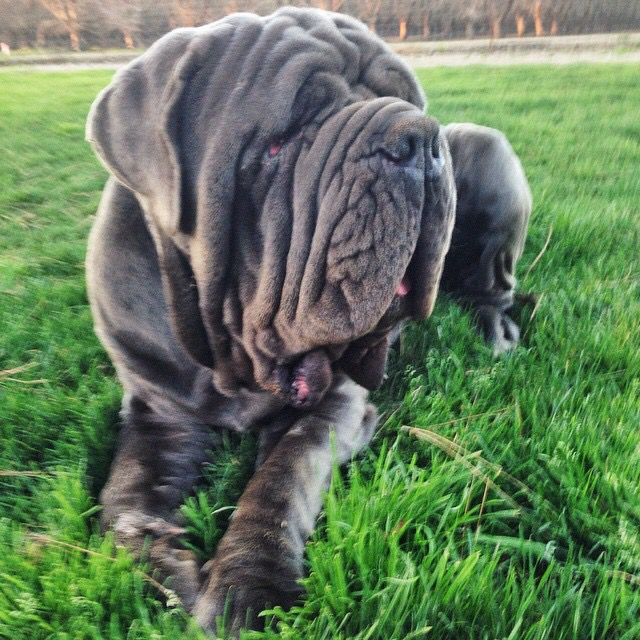
More interesting things about the Neapolitan Mastiff The Neapolitan Mastiff may be confused with the Mastiff or Dogue de Bordeaux, but the Neapolitan is more loosely jointed, has a massive head, and has much more loose hanging skin with profuse wrinkling. It may be confused with the Chinese Shar-Pei, but the Neapolitan is much much larger and has a long tail. It’s typical for male Neos to weigh well over 150 pounds. The Neapolitan Mastiff is a member of the ancient Molosser family of dogs. The Neapolitan Mastiff arose as an Italian estate and farm guardian dog. Its roots trace to Roman war dogs. Alexander the Great had a hand in creating the breed’s forebears. It is said the breed was bred to look frightening to scare off intruders on sight. In the best case, the dog could just show itself and the intruder would run screaming! It was once called the “big dog of the little man,” in reference to the fact that even everyday people could own this imposing dog. At one time they may have also been used for bear, jaguar, and bull baiting. The breed is called the Mastino or Mastino Napoletano in Italy. In America it is called Neo for short. The Neapolitan Mastiff was almost extinct after World War II because of food shortages, but has gradually increased. It was rediscovered by the outside world in the 1940s. The lumbering, sloppy gait is considered typical of the breed. Yes, they drool a lot! Neapolitan Mastiff The Neopolitan Mastiff was officially recognized by the AKC in 2004, becoming the AKC’s 152nd breed. It is a member of the AKC Working group. It comes in black, blue, mahogany, tawny, with tawny markings also called brindling. In America, the tail is traditionally docked by one third. The ears may be cropped or uncropped. The Neo is the 109th most popular AKC breed, up slightly from 113th five years ago. A Neo named Tia holds the world record for the largest litter: 24 puppies! The most well-known Neo is Fang, from the Harry Potter movies. The dog has also appeared as Alan in Babe: Pig in the City, as Pansy in several books by Andrew Vachss, and as Sweetie in Robert K. Tanebaum’s novels. They have also appeared in the movies American Gangster, Dragonheart, and Belly. Young Neapolitan Mastiff The Neo has been shown at the Westminster Dog Show since 2005, but has yet to place in the Working group. In fact, the Neo is not a terribly successful show dog, perhaps because his gait is not the usual racing clean-moving gait typical of most breeds. Like most giant breeds, the Neo has a fairly short life expectancy. This is not a breed for novice owners. I have been exhibiting dogs since 1999. I bred and exhibited some of the top ranked Bullmastiff's in the Nation. I was hired in 2009 by J.Wolf DVM to show Bruno. I was added on Bruno's Co-Ownership by J.Wolf. Bruno was an exceptional 1 in million Mastino. We made history together. Bruno was the first mastino to win a Best In Show, not only once but winning a second Best In Show.
We work on breeding the mastino in our vision of the breed. We show our dogs and want a balance. Our mastini have the folds and wrinkles and can also run, jump, play, and perform their jobs. We hand raise all of our puppies next to our bed. We have an incubator with Oxygen. We ensure the best survival and quality of life for our puppies. We work on building a relationship with our puppy buyers and becoming an addition to their families as well. We are here around the clock for our puppy buyers. Our mastini grow up in a family loving environment and the run and play on our farm in Canyon. Watching the buffalo, horses, cows, chickens and the wild turkey that visit us. We begin to temperament test the puppies around 4-7 weeks old placing them accordingly with their new families. We welcome scheduled visit here. We look forward to hearing from you. Mastini Della Forte looks for the best Neapolitan Mastiffs from around the world and cares for each one of them like family. From the pups we raise ourselves into our family pets, to the adults we add to our family, every one of our dogs is special to us. If you are looking for adult Neapolitan Mastiff dogs for sale in Canyon, Texas, we have handsome, loving pets that would love to be a part of your home. Puppies require almost constant attention to make sure they do not get into trouble. Training a puppy requires patience, time and, although the experience is rewarding to watch your dog grow up, many may not have the time or the energy to devote to puppy training. For those looking for companionship and love without a lot of training, we have well-trained, devoted adult dogs. Take a look at the pictures of our adults and contact us for more information. Tell us what you are looking for in the perfect companion, and we will help make you a match
|
AuthorApril Archives
October 2025
Categories |

RSS Feed